
Worried About Radon? Get a Clear Answer — and a Mitigation System That Works.
Certified, Iowa-licensed radon testing and mitigation across Iowa. We measure your home's level, explain what it means, and install a system that brings it below the EPA's 4.0 pCi/L action level. Free quote in minutes.
- ✓ NRPP + IDPH Certified Partner Network
- ✓ Free Quotes · No Upfront Cost
- ✓ Iowa Statewide Coverage
Who provides radon mitigation in Iowa?
Iowa Radon Experts connects Iowa homeowners with NRPP-certified, IDPH-registered radon mitigation specialists across 14+ cities. Iowa has the highest indoor radon in the US — roughly 5 in 7 homes test above the EPA action level of 4 pCi/L — and a typical sub-slab depressurization system runs $800–$2,500 with 50–99% radon reduction. Free quote within 24 hours. Call (319) 250-5558.
A statewide radon lead-routing network for Iowa homeowners.
Iowa has about 100 certified radon mitigation specialists. Most are small operators without strong online presence. We connect you with the right NRPP-certified, IDPH-registered specialist for your home — and route your project to a vetted partner in your area within 24 hours.
Iowa Radon Experts is a lead-routing service. All actual radon testing and mitigation work is performed by independent NRPP-certified, IDPH-registered partner contractors under their own licensing and insurance.
Check Your Radon Test Result Against the EPA Action Level
Enter your radon test result (in pCi/L) to see whether your Iowa home meets the EPA action level — and exactly what to do next based on official EPA guidance.
Enter the picocuries-per-liter value from your charcoal canister or continuous radon monitor (CRM) report.
How the calculator maps test results to EPA guidance
| Radon level (pCi/L) | Risk tier | EPA-aligned recommendation |
|---|---|---|
| 0.0 – 1.9 | Below average — low | No action needed. Re-test every 2 years or after major renovation. |
| 2.0 – 3.9 | Elevated — EPA "consider mitigating" | Consider mitigation, especially with smokers, children, or lower-level bedrooms. Run a long-term (90+ day) test for confirmation. |
| 4.0 or higher | EPA Action Level — fix the home | Install an active radon mitigation system. EPA recommends fixing the home as soon as practical. |
How Much Does Radon Mitigation Cost in Iowa in 2026?
The honest answer: most Iowa residential mitigation falls between $800 and $2,500 — and that's the all-in installed cost including post-mitigation verification testing. Specific pricing depends on foundation type, system design, and accessibility for venting. Here are the cost ranges that cover 90%+ of Iowa projects.
| Project Type | Typical Home Size | Installed Cost | Lead Time |
|---|---|---|---|
| Active sub-slab depressurization (standard) | Single-family, full basement | $800 – $2,200 | 1–3 weeks |
| Sub-membrane (crawl space) | Single-family, crawl | $1,500 – $3,500 | 1–3 weeks |
| Block-wall depressurization | Older home (pre-1980) | $2,000 – $4,000 | 2–4 weeks |
| Real estate closing mitigation | Any single-family | $1,000 – $2,500 | 7–14 days (expedited) |
| Sump pump radon integration | Home with existing sump | $700 – $1,800 | 1–3 weeks |
| Multi-family / condo unit | Per unit | $1,200 – $3,500 | 3–6 weeks |
| Commercial building | Office / retail | $2,500 – $15,000+ | 4–8 weeks |
🆓 Haven't tested your Iowa home yet? Get a free test kit first.
Iowa homeowners can request a completely free radon test kit from iowaradon.org (Adios Radon, in partnership with Iowa HHS and the Iowa Cancer Consortium). Kits are mailed statewide at no cost. If your test comes back at or above 4.0 pCi/L, that's when Iowa Radon Experts steps in and connects you to an NRPP-certified, IDPH-registered mitigation specialist below.
How Does the Iowa Radon Mitigation Process Work?
- Submit a free quote request — online form or phone call to (319) 250-5558. We capture your home details and timeline.
- Lead qualification — we verify Iowa homeowner status, project scope, and timeline before routing to a partner contractor.
- Partner routing — within 4 business hours, your project routes to the NRPP-certified, IDPH-registered partner contractor in your service area.
- On-site assessment — partner contractor visits within 2–7 days for a free site evaluation: foundation type, radon source assessment, system design.
- Written quote — itemized estimate including system design, materials, install, and post-mitigation verification testing. Most quotes within 48 hours of site visit.
- Schedule install — typical Iowa lead time is 1–3 weeks from accepted quote. Real estate closing timelines can be expedited to 7–14 days.
- System installation — typical 4–8 hour install day for sub-slab depressurization. Sub-membrane crawl space systems take 1–2 days.
- System activation + initial monitoring — fan activated, manometer installed for ongoing system status visibility.
- Post-mitigation verification test — 48–96 hour test starting 24+ hours after activation. EPA recommends confirmation that radon dropped below 4 pCi/L.
- Final report + warranty — partner contractor provides written verification report with pre/post pCi/L documentation and warranty terms (typically 5-year fan, lifetime piping).
Test First, Then Choose the Right Mitigation Method for Your Home
Radon Testing
Step 1 for every Iowa homeowner. Free Iowa test kits available, plus professional testing and post-mitigation verification. If your reading is below 4.0 pCi/L, you may not need mitigation at all.
Learn more →
Sub-Slab Depressurization Installation
The standard method for homes with a basement — used in roughly 80% of Iowa mitigation installs. A small pipe runs from beneath your basement slab, up through the home, and vents radon above the roofline.
Learn more →
Crawl Space Radon Mitigation
For Iowa homes with a crawl space instead of a full basement. A heavy-duty vapor barrier seals the floor, then an active fan vents radon above the roof. Slightly more involved than basement installs, equally effective.
Learn more →
Sump Pump Radon Integration
Already have a sump pump? Often the most cost-effective mitigation — your existing sump basin doubles as the suction point, no need to drill a new hole in your slab. Common in Iowa homes built after 1990.
Learn more →Not sure which mitigation method fits your home? In Iowa, your foundation type answers most of it — basement homes use sub-slab depressurization, crawl-space homes use sub-membrane systems, and homes with an existing sump pump can often integrate the mitigation system into the sump for a lower install cost. Submit a free quote and a partner contractor will assess your home and recommend the right method.
Six Reasons Iowa Homeowners Use Our Network
NRPP + IDPH Certified Partners
Every partner contractor in our network holds active NRPP Radon Mitigation Specialist certification and Iowa Department of Public Health state registration. Iowa requires both for legal radon mitigation work — we verify both before routing leads.
4-Hour Response Standard
Submit your quote request and a certified partner contractor in your area responds within 4 business hours. No back-and-forth phone tag. No 3-day delays. Real-time SMS + email routing keeps the timeline tight — especially important for real estate transactions.
Full Lifecycle Service
From initial radon testing (charcoal, continuous monitor, or alpha-track) through system design, installation, and post-mitigation verification — our partner network handles every step. One contact, complete project ownership, written verification at completion.
Real Estate Transaction Ready
Iowa Code requires sellers to disclose known radon test results. Most Iowa real estate transactions now include a radon contingency. Our partner network is experienced with closing-timeline mitigations — testing, system install, and verification within typical 30-day windows.
Free, Transparent Quotes
On-site assessment is free. Quotes are itemized line-by-line. Typical Iowa residential mitigation: $800–$2,500. No upfront cost to Iowa homeowners — you only pay the partner contractor after work is complete and verified.
Statewide Iowa Coverage
22 city service areas: Des Moines, Cedar Rapids, Iowa City, Davenport, Ames, Waterloo, Cedar Falls, Sioux City, Council Bluffs, Dubuque, Mason City, Pella, West Des Moines, Ankeny. Statewide coverage via our partner contractor network for any Iowa property.
Common Iowa Radon Questions
Cost, how a system is installed, what it costs to run, radon levels, real estate, permits, and choosing a contractor — every question answered in one place.
Read the Full Radon FAQ →Iowa Service Areas We Cover
Iowa Radon Experts routes radon mitigation requests to NRPP-certified, IDPH-registered partner contractors across 22 Iowa cities, with statewide partner coverage available. Click any city for location-specific radon data — county averages, EPA zone classification, and local geology.
Get a Free Iowa Radon Quote in 24 Hours
Call (319) 250-5558 for same-day routing to an NRPP-certified Iowa partner, or submit a quote request online. Quote response within 24 hours of submission. Free on-site assessment. No upfront cost.
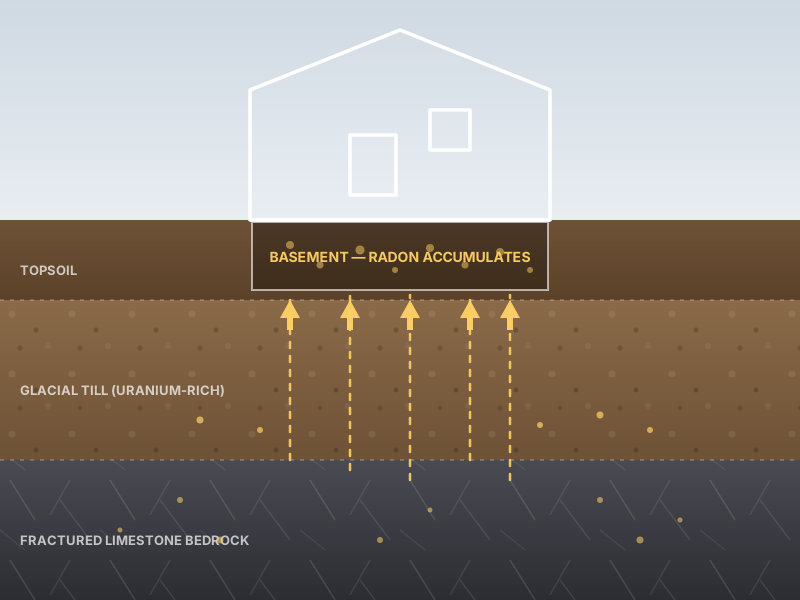
Why Does Iowa Have the Highest Radon Levels in America?
Iowa sits on a combination of geological conditions that produce more indoor radon than anywhere else in the United States:
- Uranium-rich glacial-till soils blanket most of the state — the natural decay of uranium produces radon gas continuously.
- Fractured limestone bedrock in eastern Iowa's Driftless Area provides radon transport pathways directly into homes.
- Basement-heavy housing stock — most Iowa homes have full basements, the lowest level where radon concentrates.
- Cold-winter stack effect intensifies radon entry. Heated indoor air rising pulls soil gas — including radon — into the basement at higher rates than warmer climates.
The result: Iowa ranks #1 in the United States for indoor radon per the EPA State Indoor Radon Survey (SIRS, 1993) — the foundational federal dataset establishing state-level radon rankings, which placed Iowa at 8.5 pCi/L statewide. Recent tested-home aggregations from Iowa HHS (2020-2024) show somewhat lower averages around 6.1 pCi/L, reflecting growing post-mitigation footprint and tested-home selection bias. By either dataset, Iowa is more than double the EPA action level of 4 pCi/L and roughly 5-7× the national average of 1.3 pCi/L — and Iowa retains its #1 EPA ranking.
📞 Get a Free Radon QuoteHow High Are Radon Levels in Your Iowa County?
Every Iowa county is classified as EPA Radon Zone 1 (highest risk). These are the indoor radon averages and elevated-home percentages for the 22 cities we serve, sorted by severity.
| City | County | Average pCi/L | % Homes Elevated | EPA Zone |
|---|---|---|---|---|
| Pella | Marion County | 8.5 | 64% | Zone 1 |
| Sioux City | Woodbury County | 7.9 | 60% | Zone 1 |
| Des Moines | Polk County | 7.3 | 71% | Zone 1 |
| West Des Moines | Polk and Dallas Counties | 7.3 | 68% | Zone 1 |
| Ankeny | Polk County | 7.3 | 73% | Zone 1 |
| Urbandale | Polk County | 7.3 | 71% | Zone 1 |
| Johnston | Polk County | 7.3 | 71% | Zone 1 |
| Altoona | Polk County | 7.3 | 71% | Zone 1 |
| Mason City | Cerro Gordo County | 6.7 | 61% | Zone 1 |
| Waukee | Dallas County | 6.7 | 68% | Zone 1 |
| Ames | Story County | 6.5 | 67% | Zone 1 |
| Council Bluffs | Pottawattamie County | 6.4 | 56% | Zone 1 |
| Dubuque | Dubuque County | 5.6 | 63% | Zone 1 |
| Waterloo | Black Hawk County | 5.5 | 64% | Zone 1 |
| Cedar Falls | Black Hawk County | 5.5 | 64% | Zone 1 |
| Davenport | Scott County | 4.9 | 58% | Zone 1 |
| Bettendorf | Scott County | 4.9 | 58% | Zone 1 |
| Cedar Rapids | Linn County | 4.8 | 65% | Zone 1 |
| Marion | Linn County | 4.8 | 65% | Zone 1 |
| Iowa City | Johnson County | 4.7 | 62% | Zone 1 |
| Coralville | Johnson County | 4.7 | 62% | Zone 1 |
| North Liberty | Johnson County | 4.7 | 62% | Zone 1 |
Which Radon Mitigation System Is Right for Your Iowa Home?
Five mitigation methods cover 95% of Iowa homes. Foundation type drives the choice — your partner contractor confirms during the initial assessment.
| System Type | Foundation Match | Typical Cost | Effectiveness | Best For |
|---|---|---|---|---|
| Active Sub-Slab Depressurization (ASD) | Poured-concrete basement | $800 – $2,200 | 70–99% reduction | Most Iowa homes (~80% use this) |
| Sub-Membrane Depressurization | Crawl space | $1,500 – $3,500 | 70–95% reduction | Crawl space homes (~15% of Iowa) |
| Block-Wall Depressurization | Hollow block-wall foundation | $2,000 – $4,000 | 60–90% reduction | Older Iowa homes (pre-1980) |
| Drain-Tile Depressurization | Homes with perimeter drain tile | $1,500 – $3,500 | 70–95% reduction | Newer Iowa homes with drain systems |
| Passive System Retrofit | New construction passive ready | $500 – $1,500 | 40–70% reduction | Activating builder-installed passive lines |
How Does a Radon Mitigation System Actually Work?
A radon mitigation system creates negative pressure beneath your home's foundation, intercepting radon gas from Iowa's uranium-rich soil before it enters your living space. The 4-step infographic below shows exactly how the system protects your home 24/7.
Commercial, Multi-Family, and Real Estate Radon Services
Our partner network includes specialists certified for higher-complexity radon scenarios beyond standard single-family mitigation.
Multi-Family Buildings
Apartment buildings, condos, and townhome developments require unit-by-unit testing and building-scale mitigation design. Partner contractors hold AARST-ANSI Multi-Family Measurement (MFM) and Multi-Family Mitigation (MFMT) certifications.
HUD Compliance Projects
Federally-funded multi-family housing must meet HUD radon testing and mitigation standards. Our partner network handles compliance testing, mitigation design per HUD specifications, and required documentation for ongoing federal funding.
New Construction RRNC
Radon Resistant New Construction (RRNC) builds passive mitigation into the foundation during construction — significantly cheaper than retrofitting later. Partner specialists work directly with Iowa builders on RRNC-spec foundations.
Real Estate Transactions
Pre-purchase testing, sell-side disclosure compliance, and closing-timeline mitigation — typical 7–14 day turnaround from test to verified install. Iowa real estate radon contingencies handled.
School District Testing
Iowa law requires schools to test all ground-contact occupied spaces every 5 years. Partner network provides compliant testing, mitigation design, and AARST-ANSI-standard installation for school facilities.
Vapor Intrusion Remediation
Brownfield sites and commercial buildings on contaminated land require sub-slab depressurization paired with vapor intrusion controls. Partner network includes specialists certified for combined radon + VOC mitigation.
Read Our Complete Iowa Radon Guides
Deep-dive guides on every aspect of radon mitigation in Iowa — from how systems work to choosing a certified contractor.
Radon Mitigation System — Complete 2026 Guide
How systems work, what equipment Iowa uses, and what it costs.
Read the complete guide → 🎨 With Animated DiagramHow Does Radon Mitigation Work?
Cross-section diagram of soil gas flow, fan operation, and venting.
See the diagram → 💰 PricingIowa Radon Mitigation Cost in 2026
Typical Iowa cost: $800–$2,500. City-by-city pricing breakdown.
See Iowa pricing → ⚠️ Health RiskIs Radon Dangerous? Health Risks Explained
Why radon is the #2 cause of lung cancer — and why Iowa's risk leads the nation.
Understand the risk → 🔧 Technical Deep-DiveSub-Slab Depressurization (ASD)
Iowa's #1 mitigation method — used in ~80% of installs.
Technical guide → 📊 Decision GuideRadon Testing vs Radon Mitigation
When to test, when to mitigate, and what each costs.
Compare options → ⚖️ Iowa LegalDIY vs Professional Radon Mitigation
Why DIY radon mitigation is illegal in Iowa — and what to do instead.
Read the comparison → ✅ Buyer GuideHow to Choose an Iowa Radon Contractor
Credentials to require, red flags to spot, questions to ask.
Vet contractors → 🏠 For RealtorsIowa Realtor Resources
Iowa disclosure law, closing-timeline mitigation, the real estate process.
Realtor resources →